

Xiaomi mi drone 4k or Dji phantom 3 which one will you buy? Are you still hesitating and reluctant to make dicisions? Here maybe I can help you figure it out. Xiaomi mi drone VS Dji phantom 3 standard including design, hardware, camera, remote control, Gps, Dual IMU & Image etc.
Design compare
At first glance, you maybe feel that the Xiaomi mi drone looks ugly, because of thick plastic smell. But in order to reduce the weight, all the common four axis drone use this material instead of aluminum alloy shell.
However, it still has a strong traces in many details, including modular design of DJI battery module and Yuneec CGO3 removable spherical Gimbal, and XIRO Xplorer including folding machine, foot on the remote control of mobile phone support etc. Check this link to know more about design introduction on this article XIAOMI MI DRONE REVIEW.
Image as below:

Landing Gear comparison: Folding foot type design MI Drone can completely fold flat, can through
small locking machine feet, more perfect than dji phantom 3 standard;
Gimbal and camera: Spherical lens assembly is better and more easily than dji phantom 3 standard;
Wheelbase: Xiaomi mi drone wheelbase is longer than Phantom 3, but mi drone aircraft is thinner , therefore is indeed much more portable.
Hardware compare
In the performance, Xiaomi drone is just similar to the DJI Phantom 3 specifications. No dazzling design, no automatic obstacle avoidance magic. It provides automatic flight capabilities. We will compare the hardware between Xiaomi mi drone and DJI phantom 3 as below.
Screwdriver compare
To dismantle the complete aircraft needs to be equipped with three screwdrivers: 1.5mm six inside angle screwdriver, 2mm angle screwdriver and cross screwdriver. The screwdriver which Xiaomi provided can only remove some of the screws, but DJI phantom 3 don’t give these tools. But it is unimportant for one drone, most people have these tools.
Structure compare
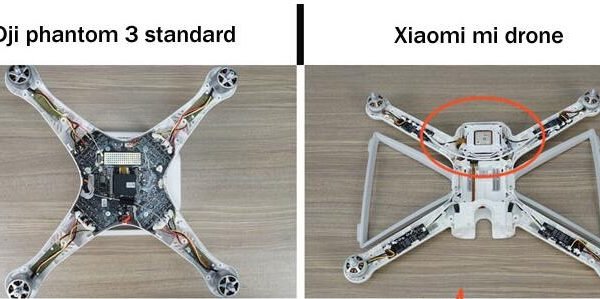
We take the whole cover down, it’s easy to take the front cover, then look at the internal structure as above image.
Aircraft Components
As you see, in order to reduce the thickness of the aircraft and can esay portability, Xiaomi mi drone central fuselage almost all left to the battery and the circuit can only be placed in the nose. And do like that it have another benefit low maintenance cost.
The body of DJI Phantom 3 s has more space, so that all the circuit are integrated together, and the battery and pilt are placed at the bottom of the fuselage . Benefits are more conducive to wiring, clean and good maintenance. Disadvantage is the high cost of maintenance, the increase in the thickness of the body is not easy to carry.
From the inner design and layout, DJI is more mature, from DJI Phantom 2 to DJI Phantom 3 with much experience. As for Xiaomi, they need to accumulate more experience in its reliability and stability for the market.
GPS and gyro
Xiaomi mi drone GPS, the main original flight control module is in the head position, the GPS module is located at the top. The GPS and gyro modules are securely protected, and the frame is very solid, with a soft sponge that can reduce the interference caused by vibration.
The protection of the DJI phantom 3 gyro is particularly good, can be described as the degree of exaggeration , plastic box is a sponge, sponge inside a metal box, open the metal box is the gyroscope.
In order to show more clearly the difference structure and design of Xiaomi mi drone VS Dji phantom 3 standard, we make a compare chart as below.
| Comparision | Xiaomi mi drone | DJI phantom 3 |
| Landing gear | Can folding | Can not folding |
| Voltage regulator chip | F850 | F330 |
| Motor | 2212 800 KV | 2312 960kv |
| Flight control | ARM STM32 F407 VGT6 Based on the advanced 32 bit microcontroller ARM kernel,its core is ARM | Safety modes include Failsafe and Return-to-Home |
| Design | Central fuselage almost all left to the battery, the circuit can only be placed in the nose | An integrated main board design, basically all the sensors and chips are placed in the middle of the main board |
The maximum transmission distance compare
Over the past year, DJI Phantom 3 in case of no interference, image transmission can be up to 5 kilometers from the spectrum, make it dominate the UAV sector last year.
Xiaomi mi drone with HD image transmission is 5.8GHz signal, rather than the Phantom 3 version of the Standard/4k 2.4 GHz, under moderate interference test, Xiaomi drones also can transmit HD images within 400 meters, the distance is similar than Phantom 3 Standard/4k.
What is the limit of WiFi image transmission? Phantom 3 and Mi drone 4K have reached 4 km FCC standard, but Mi Drone is 5G band, anti-interference even better. But Xiaomi’s official website even marked limit distance 500m, limit the height of 120m.
Camera compare
These two quadcopters are using 3-axis mechanic anti-shake gimbal, more stable than electronic anti-shake.
The camera is chief feature of Xiaomi Mi drone. They through their supply chain advantage, for the resolution of the 4K /30 frame photography portfolio, until now able to provide this combination just the DJI and Yuneec.
Mi Drone’s camera features Sony 12 megapixel sensor to record at 3840×2160 pixel resolution while Phantom 3 can record up to 4096×2160 pixel. They can both smoothly stream720 HD. Both the drones have gimbal 3-axis stabilization and can take satisfying photos in RAW. They get the same specs of ISO range, shutter speed but Phantom 3 can capture larger images (12.76M vs 8M) For the actual video and image quality, Phantom 3 provide a bit better sharpness.
Well, no one has put the real footages from the two drones together but we have this image below. It’s the comparison of Xiaomi and DJI’s 4k cameras quality. If the Phantom gets 100 points then Xiaomi mi drone will get no less than 90 points for camera quality.
Dual IMU & Image compare
Mi Drone 4K used a more advanced dual IMU and compass, theoretically can enhance the safety of the aircraft, The Phantom 3 continues the Phantom 3 series of consistent flight control and sensors, and stability is obvious to all.
Phantom 3and Mi Drone 4K are using visual positioning technology, Phantom 3 can be in the absence of GPS indoor to rely on the visual to keep hover, but Mi Drone 4K fewer than 14 GPS satellites are unable to take off . Have no idea this time Xiaomi if open the function of indoor take-off; and rely on look-down
The performance of Xiaomi in the image algorithm, is completely different as DJI Phantom 3 . Xiaomi camera traces of the latter is more intense, higher saturation, higher contrast, more positive to increase the brightness of the ISO to provide the benefits of the image, users do not have to deliberately post.
In contrast, DJI Phantom 3 imaging lines more sharp, dark detail is more abundant, the after system is also better tolerance. In other words, Xiaomi UAV is aimed at the general white users, while DJI drone is more serious for the aerial user.
The Phantom 3 Standard now actually produces great video and great stills. On the still side of things, DJI’s spec sheet for the camera says it operates with a 35mm equivalent of 20mm at f/2.8, with a max image size of 12MP at 4000×3000. It will do single shot or burst with auto exposure bracketing, and—nicest of all—it can store its images on its included SD card as both JPG and Adobe DNG RAW files.
These two UAVs are equipped with 4K camera, aperture F2.8, FOV 94 °, support 4K video and 12mp static photo shoot, which is already a very good consumer UAV configuration.
Remote control compare
Xiaomi mi drone remote control rocker and ordinary rc remote control has no much difference. And it has also add the miniature bearing with nice details. Remote control board, a receiver, transmission, batteries and other functional modules are fixed on the back shell. Main board and the installation of the remote control are located in both sides of mobile scaffold container, connected by long stitches.
Unlike the Pro and Advanced models, the Phantom 3 Standard uses a hand-held remote that very much resembles the previous Phantom 2 Vision+, although it sheds the bulky external Wi-Fi module. The remote adds a pan slider to the upper left corner so that you can control the drone’s camera without taking your hands off of the control sticks, and the left stick also locks into place when pulled all the way down, allowing you to keep the drone descending without having to maintain backward deflection on the left stick.
Xiaomi mi drone VS Dji phantom 3 standard compare table
| Comparision | Xiaomi mi drone | DJI phantom 3 |
| Flying speed | 18mps | 16mps |
| Flying time | 27 minutes | 23 minutes |
| Max Descent Speed | 1.5 m/s | 3 m/s |
| Max ascent speed | 6 m/s | 5 m/s |
| Max transmission distance | 1000 meters | 5000 meters |
| Operating Range | FCC Compliant: 0.6 mi (1 km.) | CE Compliant: 0.3 | FCC Compliant: Up to 3.1 mi ( 5 km ) | CE Compliant: Up to 2.1 mi ( 3.5 km ) |
| Satellite Positioning Systems | GPS/GLONASS | GPS |
| Controllable Range | Pitch -90° to 0° | Pitch: -90° to +30° |
| Stabilization | 3-axis pitch:-120° to 35° roll:-35° to 35° yaw:-65° to 65° | 3-axis (pitch, roll, yaw) |
| Sensor | Sony EXMOR R 1/2.3” CMOS Effective pixels:12 M | 1/2.3” CMOS Effective pixels:12 M |
| Video Recording Modes | 3840 x 2160p 30fps 2560 x 1440p 60fps 1920 x 1080p 100/60/30fps | 2.7K: 2704 x1520p 24/25/30 (29.97) FHD: 1920x1080p 24/25/30 HD: 1280x720p 24/25/30/48/50/60 |
| Max Video Bitrate | 65 Mbps | 40 Mbps |
| Operating Frequency | 5.725 – 5.850 GHz | 5.725 – 5.825 GHz, 922.7 – 927.7 MHz (Japan) |
Both of them have many features and does an excellent job of aerial photos, therefore thay are have a lot of same performance . Compare their specs, we make above table for helping you to know what’s mainly difference of Xiaomi mi drone and DJI phantom 3. We listed as you see, all of them are difference, you can choose one based on your requirements.
Price compare
| 4K drones | Sell Price | |
| DJI Mavic Pro | $1499.00 | |
| DJI Phantom 3 standard | $489 | |
| DJI Phantom 3 professional | $999.00 | |
| Yuneec Typhoon Q500 4K | $1300 | |
| GoPro Karma | $999 | |
| Xiaomi mi drone 4k | $500 |
As mentioned above, 4K drones on the market today typically cost over $500 at least. Therefore with Xiaomi 4k drone priced $500 is actually not at all expensive.
Xiaomi is attacking others manufacturers in various fields by producing fine items for amazing prices, the “price strong” well-known. The only matter is how much cheaper than Phantom 3 it is. Xiaomi has announced Mi Drone’s and it costs only $500 for the 4k version. It is nearly half of Phantom 3 Pro’s previous price $999. DJI had to cut the price of their product down to $489 . We can see from the above table, Xiaomi is not inferior to the low-end in the parameters of DJI drone, while the price is only about 2/3.
After you reading above article about Xiaomi mi drone VS Dji phantom 3 standard, which one would you like to have?
Leave a Reply